Sunday, 27 March 2022

Toomas Karmo: Immediate Monastic Reclusion Advisable: An Open Letter to President V.V. Putin and His Eminence the Titular Metropolitan of Volokolamsk

Quality assessment: 

On the 5-point scale current in Estonia, and surely in nearby nations, and familiar to observers of the academic arrangements of the late, unlamented, Union of Soviet Socialist Republics (applying the easy and lax standards Kmo deploys in his grubby imaginary "Aleksandr Stepanovitsh Popovi nimeline sangarliku raadio instituut" (the "Alexandr Stepanovitch Popov Institute of Heroic Radio") and his grubby imaginary "Nikolai Ivanovitsh Lobatshevski nimeline sotsalitsliku matemaatika instituut" (the "Nicolai Ivanovich Lobachevsky Institute of Socialist Mathematics") - where, on the lax and easy grading philosophy of the twin Institutes, 1/5 is "epic fail", 2/5 is "failure not so disastrous as to be epic", 3/5 is "mediocre pass", 4/5 is "good", and 5/5 is "excellent"): 3/5. Justification: it is arguable that I knew enough to treat my subject adequately within the limited scope I set myself.  

Revision history:

UTC=20220327T1644000Z/version 1.0.0: Kmo uploaded base version. He then planned to continue producing, in a way not documented here, minor tweaks, over the coming 96 hours, as versions 1.0.1, 1.0.2, ... . . 


I write herewith, in the format of an Open Letter, both to Monsieur le Président Vladimir Vladimirovich Putin and to a putatively solid professional theologian, Hilarion Alfeyev, Titular Metropolitan of Volokolamsk (in previous secular life Dr Grigoriy Valerievich Alfeyev). 

I turn to the titular Metropolitan as a person from my own University, although not from my own College (St John's in my case, Pembroke in his), and not quite of my own generation (we have an age difference of just over 13 years, and consistently with this he and I finished our doctoral work at university in 1995 and 1979 respectively), and not of comparable standing canonically (he, a person of high authority in the Moscow Patriarchy, and I an obscure layman under the Holy See, unconnected to any national government). Although one does not normally work the academic "Old Boy Network", working this network does become advisable in the current diplomatic emergency.  

I now solemnly ask of the Metropolitan, and I ask it in the name of Christ, daring in that Name even to bind, to the extent that a layman can in conscience bind: Your Eminence, do not leave this letter unacknowledged; have someone in your team (optimally you yourself; otherwise, some other official) acknowledge receipt, somehow, in terms that I can make publicly known, through such means

Your Eminence, you may initially ask to what extent a layman can presume to bind. In answer to this I note that if I were to seek the Sacrament of Penance from you, you could not in conscience turn me away, and that here I approach you in an analogously grave pastoral context.  

****

Appealing, then, to what I consider an unassailable pastoral-theology position as supplicant, I proceed boldly. 

Your Eminence, what may I respectfully and humbly I ask from you, having now gained the ear which you are in correct pastoral theology obliged to turn to me? I ask, once again in the name of Christ, that having in the first instance caused receipt of my letter to be acknowledged, you as a next step cause this Open Letter to be seen by appropriate persons, in such a way that its content becomes known over the coming hours to Monsieur le Président V.V. Putin. One possible intermediary in your work might be your canonical superior Patriarch Kirill, who I believe has in at any rate peacetime been in a position to communicate directly and personally with the President. But perhaps other possibilities exist for you also.  

****

Monsieur le Président, events have evolved in ways worse than those rationally conceivable when I composed my Open Letter to you on 2022-01-24. I could not resort to deliberately inaccurate language in writing to you in Open Letter format at toomaskarmo.blogspot.com on 2022-01-24. I said, in due honesty back then, that I did not think you would be so ill-advised as to launch a full-scale military invasion of Ukraine. Still less can I resort to deliberate inaccuracy in writing to you now, on the one hand (as before, on 2022-01-24) through open publication at toomaskarmo.blogspot.com and on the other hand now through the private intermediation of His Eminence the Titular Metropolitan of Volokolamsk.  

Without being exhaustive, and in particular without venturing into the details of alleged war crimes (although I do note in passing the current forensic salience of the Донецкий академический областной драматический театр in Mariupol), I set down three key points. From these you can construct the rest, as a paleontologist might reconstruct his entire dinosaur from jawbone, vertebra, and femur:

  • Your communications are in disarray. I have seen an image of absurdly primitive Red Army radio gear, allegedly deployed in Ukraine, in the form of a cheap, perhaps two-band, VHF portable, lacking encryption. This is the type of gear that might have been sold 30 years ago by Radioworld in Toronto to some frugal youngster who had just passed his Industry Canada "Basic" amateur-radio exam. And in my Internet headphones, I hear what purports to be the recording of a Red Army voice conversation regarding a search for avenues of retreat. Consistently with that primitive VHF walkie-talkie image, I note that both sides in what I hear are transmitting en clair, contrary to elementary military communications discipline. 
  • Your fuel and food are in disarray. Monsieur le Président, you can find, as I have, Internet material alleging the deliberate spillage of fuel by Red Army personnel, desperate for their own safety, seeking to halt an advance, or again YouTube ciné material showing Red Army personnel looting the shelves of a small grocery shop, or again an Internet still photo showing package documentation for a Red Army Meal-Ready-to-Eat ("MRE"). According to the photo, 2015 was the year of expiration. 
  • Portions of your troops are already in open rebellion. Monsieur le Président, I would draw your attention to Ukrainian television-interview footage of penitent Russian soldiers, begging forgiveness as they recall their participation in what I myself would characterize as a fratricidal mission. Again, I would respectfully draw your attention to the Daily Mail allegation (https://www.dailymail.co.uk/news/article-10652501/Russian-commander-deliberately-run-tank-soldiers-DIED.html) that Colonel Yuri Medvedev, from the 37th Motor Rifle Brigade, died from a vehicle attack mounted by his own men. 

Monsieur le Président, if this situation is allowed to continue, you face something more radical than the already-commenced destruction of your economy. You face something more radical than the already-commenced ruin of Russia's standing within the United Nations. You face, if not today then in 2023 or 2024 or 2025 or so, the situation V.I. Ulyanov (operationally "V.I.Lenin") faced after 1917 - the descent, namely,  of Russia from mere disorder into civil war.

****

In my "Open Letter" of 2022-01-24, I noted to you that politics is the art of the possible and the second-best. Today I address you not in terms of Realpolitik, but in ethical and theological terms, with the duly skilled assistance of His Eminence the Metropolitan of Volokolamsk. Your life has not been fully safe for years. Now, however, every day and hour counts. To extract good from your disintegrating situation now, you must use what time remains to make yourself the instrument, however weak and damaged, of God. Your position has deteriorated to a point requiring your monastic reclusion not in the near-term future, but today. 

Let others grab the levers of government, perhaps initially under your own guidance from behind monastery gates. How much power is left to you now? Surely there is some residual power, which you can exercise even from religious reclusion, should you succeed - as I conjecture you can succeed - in arranging robust, persistent, encrypted Internet communications for yourself. You retain that power through a sheer volume of administrative knowledge, amassed over two or three or four decades. Your residual power can be used to guide some events for some modest span of time, as you steer your successors away from the 2023 or 2024 or 2025 precipice of Russian civil war. 

In the monastery, you will be what you cannot hope to be outside it, namely a living refutation of the Marxist-Leninist conception of historical developments as determined and inevitable. On that dark conception, individuals are depicted as the hapless captives of overwhelming, ultimately politico-economic, "dialectical" materialist forces. You are  Christian, and His Eminence the Titular Metropolitan of Volokolamsk is a Christian, and I am a Christian; I know in the light of Easter that this dark conception is mistaken, and so does His Eminence, and so do you. 

****

Having disclaimed the intention to write in Realpolitische terms, I nevertheless do append a single Realpolitische point. With every passing hour, not only the safety of Russia at large, but your own personal safety in your alleged three principal bunkers-of-refuge, with their allegedly identical television broadcasting studios, becomes progressively less assured. From a monastery, you will be placing some physical distance between yourself and at least some of those whom I presume to be now seeking your liquidation. This is particularly the case if, working the back-channels of Holy See diplomacy, you succeed in securing refuge in some monastery outside Russia,  perhaps under the canonical jurisdiction of Rome rather than of Patriarch Kirill. 

Suppose, to take an extreme example, that you were to obtain refuge not even at some monastic foundation in Estonia or Sweden or Switzerland or the like (helpful though that would already be), but in Vatican City itself. You would in that case have abundant specialist personnel, in the form of the trained and prayerful Cohors Pedestris Helvetiorum a Sacra Custodia Pontificis, to protect you from plutonium tea, from Новичок, from treacherous doctors, and from other such hazards.  

Admittedly, if you were to take refuge in some foreign monastery or other, you might eventually - depending, perhaps, on your concrete choice of host nation - face extradition either to the International Criminal Court (ICC) or to some ad hoc war-crimes tribunal. Here, again, however, things are not quite black for you. God is merciful. Upon successful extradition from your selected monastery into civil custody, for instance at The Hague, your level of personal protection would not decline. On the contrary, it would rise still farther. No ICC panel, not even any ad hoc tribunal in the style of 1946 Nürnberg, could want its proceedings perturbed by the ill health of the individual under trial. 

 ****

How now to proceed? 

Monsieur le Président, you may find it helpful to meet your Metropolitan quietly, perhaps even with me present. Should I seem to your staff to be a potentially helpful facilitator - I stress that although you and I are culturally somewhat distanced, His Eminence the Metropolitan and I would meet as academic peers, both of us of course communicating in impeccable English from backgrounds of humanistic erudition, and with his Eminence additionally helping the three of us overcome the hurdle which is my scanty Russian - do please have your people make rapid contact with me. 

Setting personal caution aside, I respectfully suggest, Monsieur le Président, that when your people communicate, under duly convincing authentication (three-minute personal interview in your Tallinn Embassy, with your Head of Mission, with my camera running?) the wish to conduct a one-hour three-way meeting, I will boldly strive to overrule the conceivable objections of my Foreign Ministry, will cross from Estonia into Russia at some such convenient point as Koidula or Narva with my Estonian passport (being an excellent hiker, I can easily walk the final few kilometres on foot), and will pay my own economy-class fare from your frontier to Moscow by suitable buses or trains. I would seek the operational assistance of your team only in the matter of securing simple, low-cost, no-frills accommodation for one or two or so nights in Moscow, optimally in some monastery. 

E-mail obviously works (Toomas[dot]Karmo[at]gmail[dot]com). But so also does voice telephone and basic SMS text message (in both cases, as three-seven-two five-eight-six-four-six-five-four-zero). 

****

Sainte Thérèse de Lisieux, pray for us; Saint Franz Jägerstätter, pray for us; Servant of God Екатерина Фёдоровна де Гук-Дохерти, урождённая Колышкина, witness to the spiritual mission of Russia in the family of nations, intercede for us now. 

====END OF BLOGSPOT POSTING====


Sunday, 20 March 2022

Toomas Karmo: Short Open Letter to Russian Diplomats and Russian BGP-Router Administrators

 Quality assessment: 

On the 5-point scale current in Estonia, and surely in nearby nations, and familiar to observers of the academic arrangements of the late, unlamented, Union of Soviet Socialist Republics (applying the easy and lax standards Kmo deploys in his grubby imaginary "Aleksandr Stepanovitsh Popovi nimeline sangarliku raadio instituut" (the "Alexandr Stepanovitch Popov Institute of Heroic Radio") and his grubby imaginary "Nikolai Ivanovitsh Lobatshevski nimeline sotsalitsliku matemaatika instituut" (the "Nicolai Ivanovich Lobachevsky Institute of Socialist Mathematics") - where, on the lax and easy grading philosophy of the twin Institutes, 1/5 is "epic fail", 2/5 is "failure not so disastrous as to be epic", 3/5 is "mediocre pass", 4/5 is "good", and 5/5 is "excellent"): 3/5. Justification: I knew just barely enough to treat my subject adequately within the limited scope I set myself.  

Revision history:

UTC=20220320T172025Z/version 1.0.0: Kmo uploaded base version. He then planned to continue producing, in a way not documented here, minor tweaks, over the coming 96 hours, as versions 1.0.1, 1.0.2, ... . . 


In a time of crisis, we must all do what we are able to do, without harbouring illusions regarding our spiritual and intellectual capabilities. Not everyone is cut out to be a hero. God has granted heroism to some, for instance to Jan Palach (1948-1969) in Soviet-occupied Prague and to Sophie Scholl (1921-1943) under the Reich. Both paid the ultimate price for their convictions - Jan Palach through the morally defective means of public suicide, Sophie Scholl through the time-honoured, morally impeccable, means of martyrdom. Most of us are, in contrast, mediocre. 

I would apply this sobering assessment not only to myself, or again to the municipal politicians I dealt with in Canada when helping in vain from 2007 through 2018 (in those years, so many of us strove in vain for the correct conservation of the David Dunlap Observatory woodland), but even to that figure of current public ridicule which is President Vladimir "Special Military Operation" Vladimirovich Putin. 

Former KGB sleeper agent Jack Barsky (1949-; born Albrecht Dittrich; https://en.wikipedia.org/wiki/Jack_Barsky) was able to observe a young Mr Putin working in Dresden, I believe with Mr Putin then holding the KGB middle-management rank of pod-polkovnik. Jack Barsky has made it clear that in at any rate his own personal assessment Mr Putin is no genius, but on the contrary is a person who rose in the Cold War intelligence community to a respectably modest rank fitting his respectably modest abilities. 

That assessment is to my mind consistent with Mr Putin's long 2021 essay on the imagined unity of Russia and Ukraine. On reading this all the way through a little rapidly, one has much the same impression as one gains from dipping into Mein Kampf. The impression in both cases is that any B.A. student attaining  Lower Second-Class Honours, and with enough time on his hands, could, if sufficiently nutty, achieve the same literary result. Mr Boris Johnson, himself no Palach or Scholl, summed up the position deftly, a few days ago, at some podium microphone: that long 2021 essay is "Nostradamus meeting the Russian Wikipedia". 

"Kuda sam Tsar eedyot pyeschkom", people say when going to the lavatory: "where the Tsar himself proceeds on foot". Here, then, is a Tsar who rides no horse when in the loo, a Tsar who uses lavatory paper like the rest of us.   

****

The Tsar's long-term spiritual welfare I have discussed already at http://toomaskarmo.blogspot.com/, in an Open Letter to him dated 2022-01-24. I arguably ought soon to discuss it again, if briefly. I wrote that 2022-01-24 letter exactly one month before the Tsar's fatal 2022-02-24 Polenfeldzug. Back then, late in January, it still seemed that the Tsar had enough intellectual and executive ability to refrain from an outright invasion of Ukraine. I thought back then that his downfall and personal disaster impended not immediately but in the medium term. My essential 2022-01-24 points to him still hold, even though he has with his own late-February irrationality now arguably undermined his personal security even in the short term. Who, among even the best analytical minds at FSB, SVR, MI6, and the CIA, can now tell what happens with him over the coming twenty-four months, or even over the coming three?  

The concern of this present essay is not the now-perhaps-doomed Tsar but middle-management persons under him, notably in two crucial cohorts, each comprising perhaps just a few hundred highly educated persons - on the one hand his diplomats, in his embassies and consulates around the globe, and on the other hand the people within Russia who administer a particular component in his nation-wide Internet infrastructure, his ensemble of BGP-conversant routers.  

These two classes of mission-critical officer, having been vetted prior to appointment, are unlikely to include many Jan Palachs or Sophie Scholls. Although we may hope on the one hand for diplomats defecting noisily and nobly at the United Nations and on the other hand for BGP-monitoring router administrators silently leaking root passwords to GCHQ and NSA (traditional papermail, I would suggest, is a refreshingly "retro" alternative to that modern classic which is the VPN), we must not set our hopes high. Politics is in all jurisdictions the art of the possible, the art of the second-best. 

So, Dear Reader, suppose you are a diplomat or a BGP-trained router sysadmin, skilled on the one hand in your foreign languages and on the other hand in such router adjuncts as Astra Linux shell-script programming, but lacking the inner strength of a Jan Palach or a Sophie Scholl. What to do? 

Two ideas come to mind. Firstly, you can do your work not as well as before. You are perhaps in a position to plead to your superior, truthfully if vaguely, something regarding your "private emotional difficulties in the current evolving public situation", as you miss the occasional deadline and allow your diplomatic sitrep cables or the police-and-military end of your Russian BGP communications to degrade a bit. 

Secondly, you can, without attempting outright sabotage, signal quietly and truthfully that your loyalty to Vladimir "Special Military Operation" Vladimirovitch is now conditional, is now becoming a bit shaky. For juridical safety, that signal might be best conveyed not by words but by your facial expression and tone of voice. Words can be used against you in court if the Tsar somehow manages to stay in power, raised eyebrows and an ironic tone of voice not so much. To your superior, your truthful signal, however exactly you may opt to communicate it, means that you cannot now be relied on to execute silly instructions over the coming weeks. You might execute them, and then again you might not: it will all depend, from hour to hour, on the level of silliness being demanded. When this signal game is played skillfully enough, military planning gets undermined. (For what Kremlin politician can plan in confidence, if he is uncertain whom his Paris and London and Vienna and Berlin attachés might be meeting when venturing from one to another convenient First Class compartment on the train? Or what general or police supremo can plan in confidence, when he can no longer predict what his geographically dispersed lieutenants will do, as the networking among his LANs and WANs slowly degrades?) With the progressive undermining,  the current "Special Military Operation" is made progressively more difficult, and lives get saved. 

****

I compose this unavoidably troubling letter as a private Estonia-resident Estonian national lacking significant current contacts at any level of government, beyond the merely municipal, in any country. I do ask that readers try to forward the letter to senior levels within the Kremlin government and the Moscow Patriarchy. I will myself quietly bring it to the attention of the Catholic Church. If anyone feels I have overstepped moral boundaries, straying from a sincerely intended corrective messaging into outright sin, I do ask them to contact me. In the particular case of the Moscow Patriarchy, I would envisage publishing their conceivable theological rebuke, and analyzing it, here on this blog. A lack of communication from the Patriarchy to me this spring is to be construed not as an indication of their political agreement, but nevertheless as an indication that they harbour no significant theological concern with my own chosen political stance. 


====END OF BLOG POSTING====

Saturday, 5 March 2022

Toomas Karmo: Methods for Accessing Content of BBC-or-Similar from within Russia

Quality assessment: 

On the 5-point scale current in Estonia, and surely in nearby nations, and familiar to observers of the academic arrangements of the late, unlamented, Union of Soviet Socialist Republics (applying the easy and lax standards Kmo deploys in his grubby imaginary "Aleksandr Stepanovitsh Popovi nimeline sangarliku raadio instituut" (the "Alexandr Stepanovitch Popov Institute of Heroic Radio") and his grubby imaginary "Nikolai Ivanovitsh Lobatshevski nimeline sotsalitsliku matemaatika instituut" (the "Nicolai Ivanovich Lobachevsky Institute of Socialist Mathematics") - where, on the lax and easy grading philosophy of the twin Institutes, 1/5 is "epic fail", 2/5 is "failure not so disastrous as to be epic", 3/5 is "mediocre pass", 4/5 is "good", and 5/5 is "excellent"): 2/5. Justification: I worked in a public emergency on a task of limited scope, from a position of limited knowledge.  

Revision history:

UTC=20220308T065415Z/version 3.0.0Ö Kmo added information on a BBC TikTok presence and on BBC re-broadcasting through participants in the European Broadcasting Union. He raised his quality assessment for this blog posting from 1 to 2. 

UTC=20220305T153340Z/version 2.0.0: Kmo added information on BBC shortwave radio English-language broadcasts. 

UTC=20220305T085830/version 1.0.0: Kmo uploaded base version, regarding BBC Web content, as simply a bare-bones advisory. 


0. Background

Much Western news content is now banned in Russia. The BBC now offers advice, however, on the accessing of its content from within Russia. 


1. Accessing BBC content in a Web browser


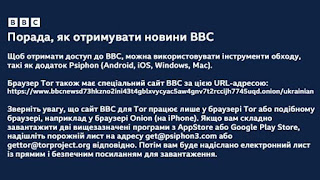
On 2022-03-04, the BBC press office gave advice on using a Web browser. 

Here is their 2022-03-04 advice in English: 


Here is their 2022-03-04 advice in Russian: 


Here is their 2022-03-04 advice in Ukrainian: 


The live-stream written-word reporting at the BBC tries to cover developments in such terse terms that readers do not suffer information overload. In the same Web-page display as it uses for its live stream, the BBC provides point-form summaries for readers who have time only to absorb the essentials. In addition to live-stream reporting, the BBC has longer articles, on Web pages separate from the live feed. 

On 2022-03-07, the BBC live Web news feed stated that it would now "be increasing access to its reporting by launching TikTok accounts dedicated to videos of the war in Ukraine in both English and Russian."

2. Listening to BBC on Traditional (Non-Internet) Radio

On 2022-03-05, the BBC live Web news feed indicated that shortwave broadcasting, in English, is now available for 4 hours each day, in transmissions which can be received in Ukraine and in parts of Russia. 

Arrangements are as follows:

  • 14:00 UTC to 16:00 UTC: 15.735 MHz (in the 19-metre shortwave broadcast band)
  • 20:00 UTC to 22:00 UTC:  5.875 MHz (in the 49-metre shortwave broadcast band) 

On 2022-03-07, the BBC live Web news feed stated that the BBC would now "be making a daily half-hour news bulletin available free-of-charge to other broadcasters who are members of the European Broadcasting Union."

I supplement the BBC information with a couple of my own remarks. 

UTC, or "Universal Coordinated Time!", lags EET, or Eastern European Standard Time, by 2 hours. UTC lags MST, or Moscow Standard Time, by 3 hours. EET is as at 2022-03-05 the normal civil time of Kyiv. MST is as at 2022-03-05 the de facto normal civil time of Donbas. 

The performance of a cheap shortwave receiver can be improved by attaching a long wire (the longer the better) to its telescoping antenna rod, and if possible leading at least a part of this wire outdoors. As a protection against both lightning and certain types of electronic warfare (the "electromagnetic pulse bomb", or EMP), the wire should be disconnected from the antenna rod when not in use. Additionally, a receiver can be protected against EMP by being enclosed in a metal box or wire-mesh cage when not in use. 


====END OF BLOGSPOT POSTING====

Sunday, 27 February 2022

Toomas Karmo: Open Letter to Platoon Commanders in the Russian Red Army Force Invading Ukraine

  Quality assessment: 

On the 5-point scale current in Estonia, and surely in nearby nations, and familiar to observers of the academic arrangements of the late, unlamented, Union of Soviet Socialist Republics (applying the easy and lax standards Kmo deploys in his grubby imaginary "Aleksandr Stepanovitsh Popovi nimeline sangarliku raadio instituut" (the "Alexandr Stepanovitch Popov Institute of Heroic Radio") and his grubby imaginary "Nikolai Ivanovitsh Lobatshevski nimeline sotsalitsliku matemaatika instituut" (the "Nicolai Ivanovich Lobachevsky Institute of Socialist Mathematics") - where, on the lax and easy grading philosophy of the twin Institutes, 1/5 is "epic fail", 2/5 is "failure not so disastrous as to be epic", 3/5 is "mediocre pass", 4/5 is "good", and 5/5 is "excellent"): 2/5. Justification: I worked in a public emergency on a task of limited scope, from a position of limited knowledge.  

Revision history:

UTC=20220228T955755Z/version 2.1.0: Kmo adjusted transparency-driven disclosure of personal contact particulars, paying closer attention to need for balancing transparency with security. Kmo then planned to continue producing, in a way not documented here, minor tweaks, over the coming 72 hours, as versions 2.1.1, 2.1.2, ... . . 

UTC=20220227T213003Z/version 2.0.0: Kmo took a firmer line, considering participation in the invasion unambiguously immoral. (In version 1.0.0, he had unwisely suggested that in some limited sense it might be moral to adhere to a solemn oath of military loyalty, taken in good faith at some past time. This is "Wehrmacht Honour", to be dismissed in the Ukraine of 2022 as it was dismissed at the Nürnberg trials in 1946.)  Kmo then planned to continue producing, in a way not documented here, minor tweaks, over the coming 72 hours, as versions 2.0.1, 2.0.2, ... . . 

UTC=20220227T203610Z/version 1.0.0: Kmo uploaded base version. He then planned to continue producing, in a way not documented here, minor tweaks, over the coming 72 hours, as versions 1.0.1, 1.0.2, ... . . 


I write in the interest of civic and military honour, as a private Estonian citizen and as a private Catholic Christian loyal to the Holy See. I assume personal responsibility for what I write, having consulted beforehand with nobody. Having, on the other hand, written my thoughts out, I am ready to take any necessary advice, correction, or rebuke from authorities in my Church and in my government, and additionally from within my circle of friends and colleagues. 

For the convenience of all parties, and in the interest of transparency, I display my contact particulars at the end of this letter. 

I respectfully request that sympathetic persons, for instance in Ukraine and Russia, repeatedly translate this letter into good Russian and repeatedly distribute it, both via social media (such as ВКонтакте) and as printed sheets, indicating that their particular translation is not my own, and retaining my own contact particulars, and if choosing to make any change in content (in substance) adding an appropriate entry to the revision log in the document header. In legal terms, this work is intended as a publication under the Creative Commons Attribution-NonCommercial 4.0 International License (https://creativecommons.org/licenses/by-nc/4.0/). 

****

What is an honourable course of action for those Red Army platoon commanders invading Ukraine who now consider their platoon to have been recruited into an unjust cause by Kremlin politicians? Of the various good options which exist for such a hypothetical platoon commander, not all are equally good. 

Some will argue that good in a weak sense is the option of remaining true to one's military oath. On this dark so-to-speak 1939-through-1945 "Wehrmacht honour" conception, one continues to fight with due diligence on the Kremlin side, as one promised when the oath was administered. For my part, however, I respectfully dissent from this assessment, holding with the 1946 Nürnberg tribunal (in which Russian judges participated) that unjust orders cannot be obeyed. 

In my own private view (I repeat my willingness to take rebuke from my government, from my Church, and from my friends and acquaintances), it is necessary to consider the military oath no longer binding. Many will agree with my anti-military assessment at least when pondering the case of such platoon commanders as joined the Ukraine invasion without initially grasping its immorality. Without myself being a soldier, I would conjecture that some aspects of military morality become clear to junior officers only in the field, at the hour when civilian anguish is first encountered. 

And in my own private view military disengagement is still more glaringly necessary for those platoon commanders who, on taking their oath months or years ago, either did not foresee being some day sent to invade the brother nation which is Ukraine or who are commanding men who did not foresee this contingency when they for their part took the oath. Officers are responsible for the moral welfare of their subordinates.  

****

How should these disengaging platoon commanders proceed? Here are various good options, some better than others. 

Good, but in a limited way, is the option of quietly undermining the work of one's higher command, in some way that does not directly endanger any other personnel in the Red Army. It would be reckless to commit an act of outright sabotage, such as planting an improvised explosive device in the path of one's advancing comrades. A descent into recklessness can be avoided, however, by executing orders less than perfectly. A lieutenant or captain radios to the platoon, for instance, the order that forty fuel containers are to be made ready for an incoming Red Army convoy. Let the fuel be of proper quality, then, prepared just as the lieutenant or captain expects. Let there simply be not quite enough of it. In place of the required forty containers, let there be just thirty, or just twenty. Or let the containers be just partly filled, with spills allowed to occur at the spigot. 

Still better is a plan of surrender, provided one can secure the free and informed consent of one's men before acting. Suppose the platoon agrees, after some minutes of discussion, that the Russian invasion is a fratricidal injustice, bringing on the one hand suffering to Ukraine, and on the other hand dishonour to the Red Army. Now one is ready, as an officer, to surrender, with the informed cooperation of one's men. Here again two options exist - both of them good, and yet one better than the other. 

The less good option is to seek out some opportunity of surrendering to a numerically superior force, by deliberately leading the platoon into contact with some larger Ukrainian unit. 

The better option is to seek out some opportunity to surrender to a numerically inferior force, as when some nine-man Russian platoon turns itself over to a two-man Ukrainian patrol. 

Surrender to a numerically superior force can take on the morally ambiguous aspect of self-preservation. Surrender to a numerically inferior force, on the other hand, takes on the aspect of a moral declaration. Such a surrender indicates to all observers, through the language of military action, a loyalty to principles and to Russia's true long-term national interest. 

[Author contact particulars: Toomas Karmo; Toomas.Karmo@gmail.com; http://toomaskarmo.blogspot.com/; telephone 372-5864-6540; papermail Observatooriumi Street, Tõravere hamlet, Nõo Rural Municipality, Tartumaa County, Estonia 61602.]

====END OF BLOGSPOT POSTING====


Saturday, 19 February 2022

Toomas Karmo: Open Letter to Ukrainian Foreign Ministry, Urging Red Army Refugee Arrangements

 Quality assessment: 

On the 5-point scale current in Estonia, and surely in nearby nations, and familiar to observers of the academic arrangements of the late, unlamented, Union of Soviet Socialist Republics (applying the easy and lax standards Kmo deploys in his grubby imaginary "Aleksandr Stepanovitsh Popovi nimeline sangarliku raadio instituut" (the "Alexandr Stepanovitch Popov Institute of Heroic Radio") and his grubby imaginary "Nikolai Ivanovitsh Lobatshevski nimeline sotsalitsliku matemaatika instituut" (the "Nicolai Ivanovich Lobachevsky Institute of Socialist Mathematics") - where, on the lax and easy grading philosophy of the twin Institutes, 1/5 is "epic fail", 2/5 is "failure not so disastrous as to be epic", 3/5 is "mediocre pass", 4/5 is "good", and 5/5 is "excellent"): 3/5. Justification: I knew enough to treat my subject adequately within the limited scope I set myself.  

Revision history:

UTC=20220219T124753Z/version 1.0.0: Kmo uploaded base version. He then planned to continue producing, in a way not documented here, minor tweaks, over the coming 72 hours, as versions 1.0.1, 1.0.2, ... . . 


I write this open letter to the Ukrainian Foreign Ministry as a publication on my server space http://toomaskarmo.blogspot.com/. I hope to convey either its text or a notification of it, via private e-mail, over the coming days or weeks to whatever parties may from time to time appear appropriate - at any rate to the Russian Embassy in Tallinn and to some Ukrainian diplomatic authorities. 

I write as a concerned private Roman Catholic layman, and as an Estonian national. I lack significant contacts, whether formal or informal, with the government of any country. 

****

As Catholics, we are aware that "our Final Examination will be on the topic of love." We are also aware that love involves following Gaudium et Spes and Fr Pedro Arrupe, S.J., in embracing "the preferential option for the poor". Finally, we recall in this context Pope John Paul II's 1991 admonition that poverty "is not limited to material poverty, but encompasses cultural and spiritual poverty as well." 

****

This winter, Russia's Red Army emerges as a new cohort of the poor. Here we find persons of limited cultural exposure and of correspondingly limited vision. I would presume these individuals are still more crushed than the US Army deserters with whom I used to chat at Catholic Worker in Toronto. At Catholic Worker, a couple of US Army personnel explained to me that in their home towns, far from the centres of American wealth and prestige, adolescents finishing high school had faced a stark, a merely binary, choice. They could work at some low-wage unskilled job, for instance as short-order cooks in a roadside hamburger restaurant. Alternatively (the one alternative), they could join the military. The military offered them their sole realistic path to a dignified adult life, dangling as it did the inviting prospect of a duly funded post-secondary education. 

The available choices cannot be much better in Russia. Now we have not only the Dostoyevskian spectacle of an Army of the Disadvantaged - a kind of Army of the Бурлаки - conceivably marching on Kyiv, but the spectacle of an Army facing military and diplomatic adversity. 

The adversity may take a while to eventuate. At first, there might be something that can be presented to Russian television audiences, far to the east of Ukraine, as a victory: air superiority quickly seized and tenaciously maintained, some Ukrainian territory gained, perhaps even a Kyiv government overthrown. But in the longer term? Things did not go well for the USSR in post-1981 Poland. Neither did things go well for the USA in post-2003 Iraq. Why should things, at any rate in the longer term, say in the five-year or ten-year term, be expected to go well for this particular Army?

****

In the face of the bleak probabilities, a means of honourable and dignified escape must now be constructed. What is needed is a clear, institutionally defined, path, free of moral ambiguity, through which a Red Army soldier can upon attaining moral clarity leave his unit and find temporary political refuge within the EU. I consequently imagine a political-refugee Non-Governmental Organizaation, "PQR", being created, at the Ukrainian grassroots level, with support from governments in Ukraine, in the EU, and in NATO. Imagine now the path of the Red Army recruit "Sergei Petrovitch", as he realizes that he has been recruited out of his isolated and impoverished community (perhaps many hundreds of kilometers east of Moscow and Sankt Peterburg, where life gets rough) into an unjust cause. Here is how the people at PQR support Sergei Petrovich, as he works to avoid moral complicity:

  • In the general confusion befogging (to take a hypothetical military example) some contested countryside some tens of kilometres northwest of Kyiv, near the Belarus frontier, Sergei Petrovich detaches himself from his unit. (Perhaps he is in a three-man patrol detail, and his two sympathetic comrades allow the detail to split up "just for half an hour", kinda-sorta knowing what is about to happen with Sergei, and willing to run their own entailed personal risks at debriefing tomorrow morning: we may well assume depression and loose discipline through much of the Red Army, once the initial weeks of euphoria are over.) 
  • Sergei Petrovich proceeds to some ordinary Ukrainian farmhouse, taking his chances as he knocks at the door. The safety catch on his firearm is clearly and demonstratively engaged. He explains to the frightened people - at first he has to shout this, since they scarcely dare open up - that he has his safety catch on, that he will toss his firearm down with its catch still on, and that he needs the help of PQR in leaving the Red Army. Eventually, people in the farmhouse understand, recalling what they already know of PQR from the media. Having accordingly let him in, they manage to find him a civilian jacket and civilian trousers, both of them a more or less reasonable fit. Helpfully, several weeks ago they did take the precaution of stocking multiple printed-out copies of a map disseminated over the Internet by PQR, detailing the location of their own oblast's network of PQR "Transit Houses". 
  • PQR now makes his way under cover of night, retaining his military compass and his electric torch, but now minus his uniform and his firearm, to the nearest Transit House. In operational terms, this is no very hard task: PQR has to cover just 30 km on foot, on rather level ground, and the map makes clear how he can proceed across fields and along farm fencing. 
  • Seven hours later, with Sergei Petrovich in the local Transit House, PQR begins the process of documenting him as a political refugee, temporarily liable to political prosecution and therefore temporarily unable to return to Russia. 
  • PQR next conveys Sergei Petrovich to the Ukrainian defence forces, some safe distance outside currently contested territory. 
  • In a courteous but firm debriefing, the Ukrainian forces record Sergei Petrovich's military particulars (rank, serial number, areas of special technical competence, ... ). 
  • The forces and PQR jointly arrange for Sergei Petrovich's speedy transfer westward, out of Ukraine, to some appropriate reception camp run by PQR and the EU. In this PQR-with-EU camp, Sergei Petrovich receives a detailed security screening from the host-nation authorities, as with Displaced Persons in the aftermath of the 1939-1945 war. With the lengthy security procedures complete, Sergei Petrovich's details are conveyed to the UNHCR database. Additionally, particulars of his family back home in Russia are entered into a database of potentially vulnerable persons, as PQR in the EU liaises with Amnesty International in London. 
  • Months or years later, once a peace treaty ends the Ukraine conflict, Sergei Petrovich is assisted by his host EU country in returning home to Russia.
  • Sergei Petrovich's conscience is now clear. He knows that despite having entered the Red Army without due consideration, he providentially found himself, once in the operational combat field, at a duly considered decision point. He knows that at that instant he did take the morally correct decision, correctly serving Russia's longest-term national interests. 
==END OF BLOGSPOT POSTING.==

Monday, 24 January 2022

Toomas Karmo: Eden-1956 Once Again? Or Jaruzelski-1981 Once Again? An Open Letter to President V.V. Putin

 Quality assessment: 

On the 5-point scale current in Estonia, and surely in nearby nations, and familiar to observers of the academic arrangements of the late, unlamented, Union of Soviet Socialist Republics (applying the easy and lax standards Kmo deploys in his grubby imaginary "Aleksandr Stepanovitsh Popovi nimeline sangarliku raadio instituut" (the "Alexandr Stepanovitch Popov Institute of Heroic Radio") and his grubby imaginary "Nikolai Ivanovitsh Lobatshevski nimeline sotsalitsliku matemaatika instituut" (the "Nicolai Ivanovich Lobachevsky Institute of Socialist Mathematics") - where, on the lax and easy grading philosophy of the twin Institutes, 1/5 is "epic fail", 2/5 is "failure not so disastrous as to be epic", 3/5 is "mediocre pass", 4/5 is "good", and 5/5 is "excellent"): 3/5. Justification: I knew just barely enough to treat my subject adequately within the limited scope I set myself. (I write as a person with exceedingly poor Russian, and with just the usual PBS-and-National-Geographic grasp of mediaeval Russian history, driven by the anxious desire to help.) 

Revision history:

UTC=202201242T212500Z/version 1.0.0: Kmo uploaded base version. He then planned to continue producing, in a way not documented here, minor tweaks, over the coming 12 hours, as versions 1.0.1, 1.0.2, ... . . 


Remarks as a Foreword,
to Assist Russian Federation Administrators 

This "Open Letter" to President Vladimir Vladimirovich Putin (1) is published in the first instance as a 2022 January 24 posting at http://toomaskarmo.blogspot.com/, and (2) is on the day following first publication being forwarded by e-mail to the local Russian Embassy address, estonia@mid.ru, with the request that it be both (a) forwarded by Embassy personnel to appropriate Moscow desks and (b) somehow acknowledged. 

Anyone (whether or not in the administration of the Russian Federation) is welcome to post a comment on this same blog, and also to post a full-scale guest essay on this same blog, under the two sets of rules set out some years ago at http://toomaskarmo.blogspot.com/search/label/AAAA--blog_intro under the two respective headings "Under what conditions may the public make comments-on-essays?" and "Under what conditions may the public post original ('guest') essays (as opposed to mere comments-on-essays) on this blog?" 


****

I am writing as a private individual, without formal or informal connections to any government, and possessing only the usual lay connections within the Catholic Church. I write as an aspiring Catholic lay hermit, outside the diocesan-hermit provisions of Canon 603, and therefore not bound by formal hermit vows. In proceeding as a hermit or hermit-wannabe, I am trying to follow, in a necessarily circumscribed and limited way, in the footsteps of Bl Charles de Foucauld (1858-1916) and - what is particularly relevant for this present piece of writing - Serv. of God Ekaterina Fyodorovna Kolyshckine de Hueck Doherty (Екатерина Фёдоровна де Гук-Дохерти, née Колышкина; 1896-1985). My readers, especially those within the Russian Federation government, might want to note two of my previous blog postings with a Russian theme: 


****

Monsieur le Président Vladimir Vladimirovich, politics has been rightly called the art of the possible, a seeking out of the merely second-best. I must stay mindful of this precept in what I respectfully write today to you and to your Foreign Ministry. 

I write with a certain personal sympathy, I might venture to say "with a certain sympathetic pity", even while having in the interests of truth to become at various points in today's letter quite brutally frank.   

****

The following are the background essentials facing both you as an individual and the Russian Federation as the sovereign state presently under your care. For some of these points, a brutal frankness proves specially necessary: 

  • The Russian Federation suffers an economic stagnation paralleling the stagnation of the Brezhnev USSR, with its GDP (the vast Russian natural resources, and the large Russian population, notwithstanding) comparable to just the GDP of Italy. 
  • In particular, the Russian Federation lags in commercially relevant engineering, with few or no significant added-value manufactures on world markets. (Where are the Russian iPads, the Russian Toyotas, even the Russian Ikea modular furniture? They do not exist.) 
  • Also serious, indeed indicating decay at the core, is Russia's scientific decline. Your young, mobile, doctoral and post-doctoral, talent in mathematics and physics in my belief migrates (do correct me if I err) almost always from Russia to the West, only in rare instances from the West to Russia. 
  • You are yourself no longer young. More than one version of a story regarding compromised personal health has percolated even to me, as a none-too-assiduous consumer of the ordinary news media, far removed from the affairs even of my tiny Estonia. 
  • Your age notwithstanding, you seem not to have publicly articulated a conception for the shape of Russian governments following your retirement. In particular, you seem not to have proposed measures ensuring constitutionality, and so blocking a mere boyar-against-boyar power struggle (blocking, that is, a dismal contemporary rerun of the 1598-1613 "Time of Troubles", or of the post-1917 civil war).  

One further background essential requires development at length. When the "Troubles" ended in 1613, it was the Romanovs who emerged on top. Only through a religious obscurantism paralleling the religious obscurantism of early-mediaeval Byzantine palace intriguers could such a process be said to have conferred political legitimacy on them in 1613. As of 1917 and 1918, however, their suffering, to the point of martyrdom, gives the Romanovs a solid claim to some admission into public life. Might not the path ahead for Russia, after your own departure, involve an eventual Dutch-UK-Nordic-style monarchy, in which the now-legitimized Romanovs exercise some limited right "to be consulted, to encourage, and to warn" (in the phrasing of UK constitutional-monarchy analyst Walter Bahehot), as they liaise with the Duma and Russia's successive Prime Ministers, under some strict new code of constitutional law? A cautious and limited embrace of the Romanovs would have a surgical effect, marking on the one hand a repudiation of that sterile utopianism which was Marxism-Leninism, and marking conversely a return to Russia's authentic living traditions. A recourse to the Romanovs might be thought radical: and yet in so ancient and conservative a society as Russia, no merely Western political gimmick could perform the surgery so urgently needed. 

****

It is against this background  that the spectre of domestic unrest, notably the spectre of unrest consolidating itself around Mr Alexei Anatolievich Navalny, impels you to a dangerous military initiative. I think - though events over the coming hours or days may prove me wrong - that your initiative does not involve anything so insane as the wide-scale physical invasion of Ukraine. My current working hypothesis is, rather, that you seek a new Kiev government in the spirit of the deposed Viktor Fedorovych Yanukovych. Under my current hypothesis, you seek to procure this régime change through backdoor processes illegal under the present Ukrainian constitution, in a context of military threat. 

Even setting aside questions of public morality, we note not only the expense, but the outright military peril, of such a line of action: once an invasion force is mustered, lower ranks are liable to pressure their commander-in-chief to move his assembled force forward, rather than to lose face in a withdrawal This danger must be prominent in the minds of the well-meaning, potentially friendly, parties in the USA who last week professed their intention to construct a "diplomatic off-ramp" for the protagonists, working to defuse current tensions. 

Whatever the nature of your initiative in its present form - perhaps I understand it accurately, perhaps I misunderstand it - it will at any rate be agreed by almost all analysts in almost all Foreign Ministries around the globe that you are now operating in a situation dominated by unknowns, in which the sheer pressure of events may cause you to lose control. More brutally put, it will be almost universally agreed, by friend and challenger alike, in Foreign Ministry upon Foreign Ministry, that you are now gambling, hoping (as a gambler might hope) for the retention of control - that you are now tossing successive volleys of dice onto the dark felt of a gaming table. 

My own guess - perhaps I guess rightly, perhaps I guess wrongly - is that however exactly events play out, as you work with lieutenants of imperfectly tested qualities in a framework of incomplete information, your initiative may culminate in your becoming a still larger figure of public derision than either the Anthony Eden of Britain's 1956 "Suez Crisis" or the Wojciech Witold Jaruzelski of the 1981 "Solidarnosc" crisis. If you are lucky, some success may come in the merely immediate term, in other words over the coming year or two. If you are lucky, you may conceivably succeed in deposing the current Kiev government, and additionally during the next year or two in keeping some kind of lid both on Ukrainian and on Russian dissent, much as Jaruzelski at first did. Anthony Eden's fall from power was swift and terrible. Yours, by contrast, might instead follow a more gradual, that is to say a less British and more Polish, trajectory. But what drama comes after, either for yourself or for your political heirs, once Moscow's casino-table luck runs out? 

****

It is in some ways helpful to write, in a broad imitation of your analysis at http://en.kremlin.ru/events/president/news/66181 ("On the Historical Unity of Russians and Ukrainians"), not just of the Russian Federation but of "The Russias", or (this is much better) of "the Rus Nations". In surveying what a previous Russian administrator - in his helplessness paradoxically a benefactor of humanity - helpfully called "our common European home, from the Atlantic to the Urals", we find not just the Russian Federation, but Belarus. And in that same broad cultural space, we find Ukraine. 

I do hedge this remark with the caveat "helpful in some ways". Ukraine has its own distinctive ethnological patrimony, even its own language, and in contradistinction from the Russian Federation  is theologically partitioned between a Byzantine interpretation of Christianity and a straightforward canon-law allegiance (under Byzantine liturgical forms) to Rome. But the three "Rus Nations", distinctive Ukraine among them, do mark out a cultural mosaic for which many or all of the other Slavic nations, notably Poland, within our "common European home" are externalities. 

What, now, is the cultural mission, the task or duty, of this trio of large "Rus Nations"? You and I, chronologically almost exact contemporaries, know the answer, perhaps about equally well: you, as a longtime head of government in the largest of the three big "Rus Nations", and I as a close, formerly Estonian-exile, observer of the decadent Anglosphere (with four years at Oxford, and with a history of employment in Australia, in that former British centre which is Singapore, in the USA, and above all in anglophone stretches of Canada). You and I are both painfully, even contemptuously, aware of Western decline and decadence, spearheaded as it has been since 1945 by Anglosaxonia, and evident also in such presently (temporarily?) respectable European-Union jurisdictions as Estonia. Only a terse recitation of illustrative points is necessary to recall for you and me, well informed as we jointly are, the downward communal trajectory:

  • The eager following not of political opportunists alone, but even of superstitions (as when thousands upon thousands of English speakers stridently insisted that the current pandemic is a "hoax"; although they have given that up now, soon they will have something else, such as a revival of the extraterrestrials-in-our-midst meme; before the "hoax pandemic" talk, there was their strident numerological-superstition insistence that the world would end on 2012 December 12; or again that, media reports to the contrary, pop singer Elvis Presley was alive and well; or again their strident insistence that Adolf Hitler, alive no less than vinyl-recording idol "Elvis the Pelvis", was in the First Gulf War proffering military advice to Mr Saddam Hussein: it is characteristic of this mass mania - an Anglosphere phenomenon with notable resonances also here in Estonia - that it finds some new object every five years or so). 
  • The illiteracy (as with YouTube street interviewees, speaking English as their native language, who are baffled when asked to "name a country starting with U", or again to state the number of sides in a triangle). 
  • The spectacle in Canada, the USA, and the UK of thousands upon thousands of homeless sitting with their begging caps and begging bowls on the downtown  sidewalks, in some cases  outright incoherent - and in perhaps the majority of cases although coherent enough, nevertheless in need of psychiatric support (I have chatted with many, in Toronto) - with the Canada-USA-UK authorities cynically calculating that the homeless "do not vote", that in any case they are in some subtle sense "to blame", that things will be okay for them if they somehow "get jobs". 
I could spell this out further by citing a sporadic English-language Pope-bashing fundamentalism in the Roman Catholic Church (there are, for instance, USA pulpits from which it is asserted that it is a sin to vote Democrat; I have heard layman suggestions along these shameful politicized lines even here, over so-to-speak post-Mass coffee, in Estonian, outside the hearing of our clergy), or again by citing the "Dark Web", or again by citing opioid abuse, or again by citing court news (as with the Jeffrey Epstein and Elizabeth Homes convictions). But I think my point is clear enough by now, needing no elaboration. The West is going down (has, in the opinion of many, been going down pretty steadily since the summer of 1914), and the three big socially and theologically "Rus" nations are consequently among those now called to bear a countercultural witness. 

Your erudite  http://en.kremlin.ru/events/president/news/66181 essay would, in my own respectful view, be improved if it were to further develop this theme of an emerging call to countercultural witness. 

In addition, I respectfully submit that your essay suffers from a mistaken assumption, in part overtly stated, and in part an easy extrapolation from the much that you do state. Your essay mistakenly assumes that the three big "Rus Nations" require leadership with a single dominant centre of authority, as some Muscovy to which regional centres are made subservient. I submit that it is not this monolithic Muscovite model, but a multipolar model, that is truest to the actual lived experience of the the large "Rus" peoples. In the broad sweep of the Rus, from the emergence of their first chroniclers onward, as the "Nations" positioned their emerging self-awareness under the complex - in its cut-throat internal palace-politics traditions unhelpful, and yet in its civil jurisprudence, in its art, and in its theology helpful - influence of Byzantium, the rise of Muscovy is a mere early-Modern development. It is no more remote in our collective past than the early-Modern end of Byzantium itself, when the Tallinn cobblestoned Old Town here in Estonia contained much the same set of fortifications and churches, and even many of the same burgher-merchant  houses, as it now does. For these "Nations", a happier, multipolar, political model is available from earlier in the course of Rus self-awareness - from the Byzantium-inspired, early-Christian, post-Vladimir, epoch of Kiev and Novgorod, of Pskov and Tver and Uglich. 

Your detailed and erudite essay notwithstanding, a centralized leadership is unlikely to now facilitate the emerging cultural mission of the three big "Rus Nations". Such a leadership will instead now undermine the mission, reinforcing in Western minds the stereotype of a Muscovite tyrant, much in the mould of shoe-pounding First Secretary Nikita Sergeevich, from whom the West has nothing positive to learn. 

****

Since politics is the art of the possible and the second-best, I must offer you only small suggestions. I proceed from the pessimistic premiss that your gambling-hall initiative, whatever its precise present character, and whatever feats it may accomplish in the next couple of years, as your successive volleys of dice hit the dark casino-table felt (an unconstitutional change of government, perhaps, in Kiev?), longer-term failure impends. Taking, for the sake of my attempted help to you, your eventual misfortune as a given, I try to consider what form of damage control would best serve the overall emerging cultural mission of that collective which is the trio of big "Rus Nations": 
  • As your last public act, when you stage your personal exit from an increasingly disordered  situation  (in 2024? in 2026? as late, even, as 2030?), you install some Romanov as some minor public Russian functionary. You do this by way of sowing a small, nonprovocative, seed, for possible gradual development by your increasingly beleaguered successors, conceivably in the 2040s or 2050s or 2060s. 
  • You retire from public life to some appropriate monastery, making a suitably austere transition from politics to penance, reflection, analysis, and scholarship. Here you influence the three-nation Rus evolution more deeply than you could hope to influence it from your increasingly insecure position as a Kremlin administrator. Your penance is a large component in your religious reclusion. - I need not develop that last point at length: it is enough to mention, with the utmost brevity, Boris Yefimovich Nemtsov and Salisbury, and to remark that there is likely to be more. 
  • Your monastic reclusion involves some degree of engagement with Katya Fyodorovna (the already-mentioned Екатерина Фёдоровна де Гук-Дохерти, née  Колышкина), with whatever supplementary help the Holy See may be able to give you as you occasionally seek low-key Roman advice to supplement what good advice you are receiving from your own Byzantium-anchored Church. 
Zagorsk or Valaam might be possibilities for this life of monastic reclusion. But if you were to select instead the early-Modern (1473) Petseri-Pechory monastery, so close to the present Estonian line of de facto state demarcation (and lying just within the Estonian fold of the old 1920 Treaty of Tartu de jure demarcation), then I could visit you twice a month. Such a programme of visits would not involve much trouble or expense on my part. It would be a simple matter of my taking the train from Tõravere to Tartu, then taking a second train from Tartu down to the de facto frontier platform of Koidula. Should the Russian Federation authorities give me the necessary visa for my Estonian passport, it might prove easy enough to walk the few kilometres separating the Koidula platform, on the Estonian side of the demarcation line, to your monastery gates, on the other side. I would imagine conveying occasional useful books to you in my small knapsack, subject to due inspection by your frontier authorities. One such book might be Katya Fyodorovna's English-language bio, They Called Her the Baroness (by L.H. Duquin), which we could discuss together over our numerous glasses of tea. More broadly, I would try, without hearing your confessions or exploring your penitential programme,  to give you a bit of help in your new life as an author-analyst. I think I could do this, even given the modest limitations imposed by my modest autism, without either forcing my own opinions onto you or compromising my own private principles. 


Begging to remain, 
Monsieur le Président Vladimir Vladimirovich, 
your faithful Estonian correspondent, 

Toomas Endel Karmo


Remarks as a Postscript, to Assist Russian Federation Administrators


The Russian Federation diplomatic authorities will have to consider the correct form of response for such an eccentric communication. The form chosen will be governed by the message which the Federation desires to communicate in reciprocation. If the Federation seeks to communicate a message of deprecation, in other words of dismissal, then it will be appropriate to transmit no acknowledgement at all (and I will then explain on this blog, having waited 48 hours, that no acknowledgement has arrived in my e-mail). If the Federation seeks to communicate a neutral  message, to the effect that normal professional courtesies are being observed, than it will be appropriate to use some such form of words as "We thank you for your e-mail of 2022-01-xx, headed xxxx. (signed) xxxx xxxx xxxx" (and I will then report the acknowledgement on this blog). If the Federation seeks to convey some small hint of warmth, then it will be appropriate to use some such form of words as "We thank you for your concern at this difficult time," or again "Dr Toomas Endelyevich, we appreciate your anxiety and concern, while being at this time regretfully unable to discuss your points in detail" (or whatever; and I will then report the acknowledgement on this blog, noting its constructive tone). 

Friday, 12 February 2021

Toomas Karmo: Prof. C.T. (Tom) Bolton (1943-2021) and the 2007-2018 DDO&P Defence Crisis

Quality assessment: 

On the 5-point scale current in Estonia, and surely in nearby nations, and familiar to observers of the academic arrangements of the late, unlamented, Union of Soviet Socialist Republics (applying the easy and lax standards Kmo deploys in his grubby imaginary "Aleksandr Stepanovitsh Popovi nimeline sangarliku raadio instituut" (the "Alexandr Stepanovitch Popov Institute of Heroic Radio") and his grubby imaginary "Nikolai Ivanovitsh Lobatshevski nimeline sotsalitsliku matemaatika instituut" (the "Nicolai Ivanovich Lobachevsky Institute of Socialist Mathematics") - where, on the lax and easy grading philosophy of the twin Institutes, 1/5 is "epic fail", 2/5 is "failure not so disastrous as to be epic", 3'5 is "mediocre pass", 4.5 is "good", and 5/5 is "excellent"): 3/5. Justification: I knew enough to treat my subject adequately within the limited scope I set myself, but did not know enough to be able to widen my scope beyond my chosen theme of practical civics, as would be required in the case of an ambitious, full-scale, obituary. 

Revision history:

  • UTC=20210921T080800Z/version 1.2.0: Kmo corrected a factual error in the matter of Councillor Karen Cilevitz, changing the erroneous wording "trial date" to the correct "initial court date". The initial court date of 2021-04-01 was followed by other court dates, and as of UTC=20210921T080800Z Kmo did not know whether Karen's case would be brought to trial. He had fallen into the factual error through ignorance of Ontario criminal administration. 
  • UTC=20210222T102200Z/version 1.1.0: Kmo corrected "microscopist" to "micrometrist", in the discussion of the two Struves. He reserved the right to continue producing, in a way not documented here, minor tweaks, over the coming 120 hours, as version 1.1.1, 1.1.2, ... . 
  • UTC=20210212T195850Z/version 1.0.0: Kmo uploaded base version. He then planned to continue producing, in a way not documented here, minor tweaks, over the coming 120 hours, as versions 1.0.1, 1.0.2, ... . . 


1. Prof. Tom Bolton in Scientific and Civic Service 

A leading Canadian observational astrophysicist, and Fellow of the Royal Society of Canada, Prof. C.T. (Tom) Bolton, born in the USA in 1943, died a few days before 2021 February 5. I belive he died alone, in his home near Ontario's David Dunlap Observatory and Park (DDO&P). When I received the news, on February 7, the coroner had not yet determined a date of death. I imagine that something like February 1 or February 2 or February 3 is close to whatever official finding will in due course get made. 

I will leave it to more qualified writers to discuss Prof. Bolton's work, both on high-velocity hot stars (the "OB runaways") and on his identification of the first stellar-mass black hole candidate. 

I am not competent to write anything at all on the OB runaway-star work. 

Concerning black holes, it suffices here to remark, briefly, that Prof. Bolton put the DDO 1.88-metre telescope to successful use. His spectrogram plates of the ninth-magnitude star HDE 226868 built up part of the case (with another part contributed independently, by Webster and Murdin in the UK) for the hypothesis that the HDE 226868 binary-companion X-ray source, Cyg X-1, is a hot accretion disk girdling (not a mere neutron star, but more radically) a black hole. 

This was the first stellar-mass black hole candidate known to science. When I checked with an appropriate specialist, perhaps around 2018, only around thirty other such subsequent candidates had been identified. Here, then, is one of the five or ten principal observational results in 20th-century astrophysics. 

Prof. Bolton's achievement came through hands-on labour and deep thinking. It came despite the modest size (in international terms, from the 1970s onward) of what was at the time, and still is, the largest telescope in Canada. 

While others have written in a pessimistic vein about the problem of light pollution at DDO, the  facts are these: (a) The light pollution has been rather steady, rather than suffering a severe rise, since the 1980s, in other words since the ten or fifteen years following Prof. Bolton's spectroscopy. (b) With a liquid-nitrogen-cooled digital camera, as opposed to the chemical-photography plate technology available in the early 1970s to Prof. Bolton, it was routine for us in the DDO of 2008 to take good spectrograms of stars much fainter than the ninth-magnitude HDE 226868. We could push down, with acceptable signal-to-noise ratios, to perhaps magnitude 11 or magnitude 12, or still fainter.

In my earlier days with Prof. Bolton, from 2006 November, our conversations  turned on my observing duties for him at the 1.88-metre telescope, and on my related daytime duties of one-dimensional spectrogram extraction for him, via the IRAF software suite, from the digital spectrograph-camera files. 

I admired the name he bestowed on the high-grade Linux workstation which housed our endless IRAF work. Some years before I became Prof. Bolton's research assistant, and surely without any notable knowledge of Estonian astronomy, he had designated his imposing machine struve.astro.utoronto.ca. His choice for that "Fully Qualified Domain Name" was a salute to Otto Struve (1897-1963), a USA-based Russian-emigré great-grandson of a Baltic-German authority remembered here in Estonia as a principal luminary of the Tartu Observatory, namely the binary-systems filar micrometrist Friedrich Georg Wilhelm von Struve (1793-1864). The salute was in its turn an indication of what I prized in Prof. Bolton, a dedication to observationally grounded physical insight. Otto Struve (and indeed in an indirect sense even his ancestor, the tsarist binary-systems pioneer Friedrich Georg Wilhlem) is a contributor to the physical analysis that transforms mere astronomy into the duly high, duly severe, discipline of astrophysics. 

For a while stars, and also occasionally mildly scandalous retellings of old dome gossip - I nowadays treasure Prof. Bolton's story of the misfortune which befell stellar astronomer "PQR", of Slavic-outside-European-Union extraction at McDonald Observatory in Texas - were the staples of such conversation as pressure from our respective DDO duties made occasionally possible for us. (It was a good story. Prof. Bolton told it well, with a good Hollywood-Slavic intonation. The temperamental "PQR" was on one particular night specially truculent, and complained in the Texan dark to a night assistant or some such, "I am zee greatest astronomer in zee VÖRLD." At this point he took a step backward in the gloom, to underscore his superiority, and with disastrous consequences fell from quite a height off a platform. As Prof. Bolton told me the story, PQR subsequently judged it appropriate to sue the McDonald administration.)

With, however, the 2007 September 10 announcement by the University of Toronto that the David Dunlap Observatory and Park (DDO&P) would be sold on the open market, a new side of my boss emerged. Some people have a seemingly innate affinity for marathon running, or again for dance, or again for mathematics, or again for sculpting. As the DDO&P conservation crisis unfolded, from that September Monday morning onward, it became increasingly clear that Prof. Bolton had an affinity for civics. 

This is a thing not so commonly encountered even in the ranks of eminent professional politicians. In all my life of peregrination and incident, I have met only a few people with this virtue. There was, for instance, the so-serious lad, aged perhaps ten, on the train, in the summer of 1974 near Munich. His dad, he told me, was an official of some weight at the United Nations. We discussed public affairs in English, on a rather statistical basis, I think standing uncomfortably in the so-crowded second-class corridor, for perhaps a half hour. It was as though the whole weight of the troubled planet rested already on his shoulders, as it surely rested on the shoulders of his distinguished dad. - What can have become of that boy? He is likely to be at late-career stage now, with grey hair and grandchildren. Is he, like his father before him, with the United Nations? Is he, alternatively, an Ambassador, or perhaps a First Secretary or Second Secretary, in some London or Washington or Paris embassy, representing in ever-so-excellent English whatever significant nation may be his ancestral homeland? Or did his innate talent somehow get smothered in adolescence, as talent can be where mentors and tutors prove unequal to their grave responsibilities? 

Before I can develop Prof. Bolton's civic side in detail, I must digress - supplying, to those of my readers who may desire them, pointers to briefing materials on what might now be termed "the 2007-2018 DDO&P Defence Crisis". 


2. Essentials of the 2007-2018 DDO&P Defence Crisis

What I here call the "Crisis" seems in fact to have been the weightiest Canadian heritage-conservation case of its time. I offer this assessment with some confidence, having glanced more than once at what other alarming things were on Canadian heritage-conservation desks in those eleven years. There were various individual buildings of note - the subsequently rescued "Normal College" in the Nova Scotian town in which I was born, and where my exiled father was serving in a agronomic civil-service capacity, a historical exhibition hall somewhere out West, remains of  diminishing Canadian church life. In the province of Québec, an entire monastery or convent faced possible demolition. A village streetscape, I am fairly sure on some small Lake Ontario island, was in similar danger. Nevertheless, it seemed that nothing at that time could quite equal the case of 77 hectares of urban greenspace, perhaps half of it under forest cover, housing one of Canada's three internationally significant observatories, and constituting an ensemble which under more visionary municipal, provincial, and federal guidance might by 2015 or 2020 or 2025 have hoped to attain inclusion in the UNESCO World Heritage List. 

In the end, the Crisis turned out badly, with all buildings but the 1970s-era gatehouse conserved, and yet with research spectroscopy at the 1.88-metre telescope indefinitely suspended. The 1.88-metre was now put to the humblest of uses, fitted with a mere eyepiece, as appropriate for public outreach. Of the 77 hectares, 32 were ceded to property developer "Corsica", in 2015 renamed "DG Group". The latter name surely signifies a flagship for the commercially prominent De Gasperis family, whose collaborators on DDO&P subdivision development included the equally prominent Muzzo family. (It should perhaps be noted here, in the interest of moral clarity and to prevent speculation by the excitable, that the Marc Muzzo who was a director of Corsica during the Crisis is not the  much-discussed convict Marco Muzzo, granted full parole on 2021 February 9, but his paternal uncle. I have no knowledge of any criminal allegations against the senior Muzzo. - I did make a feeble effort at investigating the De Gasperis family, mindful of such things as the local Mafia, reputedly anchored not in Sicily but in the 'Ndrangheta grouping of Calabria. My one semi-inside source, in a short chat, led me to think that circumstances do not point in anything like an 'Ndrangheta direction, or in any other criminal direction, and indeed point rather in the direction of moral, duly Catholic, probity.) Those wishing to see what the Corsica destruction of forest looked like can view footage, taken by some drone operator not known to me, at https://www.youtube.com/watch?v=VQuHx-7QAKw (YouTube upload of 2015 May 13, by YouTube user "Beygin Media", under the title "Fallen trees - Richmond Hill aerial of Dunlap Observatory Hill home development"). Those seeking an impression of the subdivision that has replaced the forest might visit https://myobservatoryhill.ca/ or http://www.aspenridgehomes.com/new-homes/Richmond-Hill/observatory-hill. 

The temporal demarcation of the Crisis is easy. It started, as already noted, on the morning of the Monday which was 2007 September 10. That was the morning a press release from the University of Toronto, announcing an intention to sell, landed in the e-mail inboxes of DDO workers. The three Dunlap grandchildren had evidently at last caved in, the language of Jessie Donalda Dunlap's 1932 Deed of Indenture, barring sale of the so-generously donated facility, notwithstanding. And I suspect none will dispute my dating of the Crisis end, as the afternoon of the Saturday which was 2018 June 9. 

On that particular Saturday, previous provisional arrangements for public education or "public outreach" at DDO, under the auspices of the pro-am astronomy-education specialists of the Royal Astronomical Society of Canada (RASC; http://www.rasc.ca/) were formally replaced by a programme of public outreach under proper municipal auspices, involving both RASC and the DDO Defenders (DDOD; http://ddod.ca/). The Mayor spoke, other municipal dignitaries, as I think I recall, spoke; I presume DDOD spoke well; I vividly recall RASC speaking, with a fine command of facts, of the history of DDO in Canadian astrophysics; the citizen-engineering YLab group mounted instructive displays, and offered a friendly welcome, in the DDO basement laboratory area; and people in the big crowd shook hands in a spirit of sincerity. My impressions of that Saturday, with an analysis of its positive conservationist significance, are available at http://toomaskarmo.blogspot.com/2018/06/the-ddo-conflict-2007-09-10-to-2018-06.html. 

Further materials on the 2007-2018 Crisis are available by clicking on the right-margin "DDO&P conservation case" hyperlink at http://toomaskarmo.blogspot.com/. Many of the blogspot postings under that link, reflecting detailed week-to-week work of Mayor and Council, will be of interest primarily to specialists in municipal affairs. At least two, however, might be useful to a wider audience: 

Not under that hyperlink, but also relevant, is the following:

For full clarity, and to forestall adverse speculations within some of my readership, it is advisable to conclude this briefing with bare-bones points about DDOD: 

  • DDOD, founded late in 2007, was taken over, de facto if not at first de jure, by political aspirant Ms Karen Cilevitz in the spring of 2008.
  • Ms Cilevitz and DDOD played a fully constructive, in other words a fully conservation-supportive, conservationist role until at least 2010, as detailed at http://karen-vs-toomas-blog.ca/20140218T035440Z____blogpost/NNNN____20140218T035440Z____blogpost__main.html. 
  • Ms Cilevitz had during this period the fully appropriate approval and support not only of me as an administratively and scientifically junior figure but (what is significant, and moreover speaks to her good side) of Prof. Bolton. Additionally, she had a constructive relationship with the principal conservationists in the Crisis, Prof. Bolton's staunch friends (and equally my staunch friends) the Richmond Hill Naturalists (https://www.rhnaturalists.ca/). 
  • The key 2011 DDOD decision to support subdivision development on 32 of the 77 hectares, thereby undercutting (perhaps fatally, perhaps not fatally) the potential federal-government DDO&P World Heritage List case, is to be laid more at the door of Ms Cilevitz than of other, still-active, DDOD personalities, at that time administratively subordinate to her within DDOD.
  • The key movers in this 2011 disaster were in any case not DDOD but the developer and the municipality, as the de facto principal parties in closed-door negotiations at the then still-functioning Ontario Municipal Board. DDOD participated in the trap which was closed-doors negotiation through Ms Cilevitz's error in judgement, and had only a minor influence on the outcome of the protacted parleys - I suspect not much beyond the rescuing, and the relocation within the DDO&P remnant, of the little 1930s DDO "Pump House". 
  • The current Karen Cilevitz criminal case, frightening though it may prove today, as her initial court date of 2021 April 1 approaches, has to the best of my limited knowledge no connection with the DDO&P conservation file. As we monitor her evolving case, we do well to remind ourselves that her two charges notwithstanding (fraud over 5000 CAD, breach of trust by public officer), everyone is in law innocent unless and until the court issues a finding of guilt. I also herewith reiterate my various calls over the years, at blogspot and elsewhere, for a reconciliation between Karen and myself, even while herewith refraining from comment on the terms of her and my 2014 out-of-court settlement. (It was not I who sued her, but she who sued me.) 


3. Prof. Bolton in the 2007-2018 DDO&P Defence Crisis

Part of what comes to mind in the specific DDO&P civic context of Prof. Bolton is, inevitably, suffering. 

I recall his ejection, in 2008 July, from the Administration Building of the distinguished facility to which he had in a broad range of scientific and administrative capacities devoted much of his distinguished career: he was in tears, and if I recall accurately sitting, like the Observatory outcast he had become, by some cardboard boxes of items from his office. And yet I had not previously found him inclined to displays of lachrymose emotion. I recall, as a further cruel twist of this knife - eminently useful to us on the conservationist side, in our coldly militant, and fully necessary, ruthlessness, but nevertheless cruel - the to-us-unexpected National Post photography of Prof. Bolton at the doorstep. It was in these loud terms that our communal unhappiness got communicated not to the Greater Toronto Area alone, but to pretty much every Canadian newsstand. 

From the same troubled month, quite likely from the same surreal day, I recall Prof. Bolton listening attentively near the Administration Building doorstep when I vented civic emotion in operatic mode, opening the dome catwalk door to the daytime sky and delivering appropriate commentary from that vast hemispherical reverberation chamber. I had for some months steeled myself for the worst by secreting in the telescope control room, and on suitable dome occasions practicing, the Dies irae. It was therefore (as I also recall in the "Islands in a Time of Civilizational Decline" essay, Part C, as cited above) easy enough for me to use the reverberation to amplify my already-strong tenor, so that the grieving scientist could hear also, even stationed, as he was, some tens of metres away. Dies irae! Dies illa! Solvet saec'lum in favilla ... ("Day of anger, that Day!  It will dissolve the world into ash," and so on and so on, for nineteen pitiless stanzas which outdo even the Finlandia hymn's powerful "Oi Suomi, katso, sinun päivas' koittaa"). 

Recall offers also, however, happier moments from Prof. Bolton's civic engagement. 

There were Prof. Bolton's contributions as a key witness, at the hearings of the  Conservation Review Board (CRB) in 2009 (where we obtained a broadly favourable verdict) and at the Ontario Municipal Board in 2012 (where our verdict was astonishingly adverse). He spoke clearly, without superfluities, to the point, evidently unshaken by the efforts of the developer's counsel. His serenity under fire must have been due chiefly to the innate civic affinity which is the principal theme of this present obituary notice. Surely also helpful at CRB was the sage advice from someone on our side, from within the ranks of the consistently conservationist Richmond Hill Naturalists. Someone (not me) from that grouping had said to him, wisely, "Tom, just go there and enjoy yourself." And so he in a way did, even while under the dreaded "Cross", when the opposing advocate can throw any subtle curve-ball question, and within tribunal rules even any unintentionally or intentionally upsetting question, at you. 

Further, many hundreds will recall with gratitude Prof. Bolton's braving winter weather to speak, with a troubling cold and well scarved, to the podium microphone in our big 2008 protest meeting on the grounds of the Ontario Legislative Assembly, in downtown Toronto, across the street from the main University campus. This was the day on which we delivered a conservationist petition with several thousand signatures, in its original to the Legislative Assembly via our Member of Legislative Assembly, and in photocopy to "Vice-President, Business Affairs" Catherine Riggall at the University. The conservationists do not seem to have preserved a YouTube record of those particular podium remarks. Something of their flavour, however, can be inferred from a surviving YouTube record of other podium work, in which Prof. Bolton, at the steps of the DDO Administration Building, addresses a crowd of perhaps fifty or one hundred or two hundred (perhaps not on that occasion, as I now think, significantly over one hundred). He can be seen speaking with passion in check, as required of the results-oriented civic activist, and yet arguing (as likewise required) without compromise, all his pertinent points duly marshalled, with little or no padding, at https://www.youtube.com/watch?v=7acKj-DB2Ak. (This it the YouTube upload of 2008 February 10, by former DDO Telescope Operator Jim Thomson, under YouTube username "jrthomson1", under the title "David Dunlap Observatory sale protest".)

And I recall the hope which he infused into the immediate DDO family in the initial days of the Crisis. A meeting was hastily convened in his Administration Building office. Perhaps half a dozen of us were present. The atmosphere was electrifying, perhaps more than in any other small meeting I have attended. It was  clear that we would fight with all the peaceful and legal means at our disposal; there was no self-pity, no grandstanding, and as I now recall it not even any discernible pessimism. 

Above all, there is a thing from Prof. Bolton which antedated the 2007-2018 DDO&P Defence Crisis by a couple of decades, and which - as I will shortly explain - serves now as his best, as his most concretely operational, civic contribution. One might now term it his most fitting civic memorial. 


4. By-law 63-95 as a Bolton DDO&P Defence Legacy

Various things will have to be done if the 45-hectare DDO&P remnant, and DDO within it, are to be adequately protected over the coming years. Some of them are to an encouraging extent now being done. 

The municipality, having been complicit in greenspace destruction, is now redeeming itself with a duly heavy investment in restoration of the DDO domes and masonry (to, it seems, correct heritage-conservation standards). 

Although there is an ever-present danger of DDO&P degenerating into an astronomically themed Disney World, DDOD under its current executive is duly aware of the need to start up a programme of scientific research, and has already made some  steps in this so-necessary direction of "citizen science". I like to think that this DDOD initiative will help pave the way for eventual parallel efforts by DDOD's public-outreach co-worker, RASC. 

Additionally, we may hope that, as the passions of the 2007-through-2018 period cool, it will be increasingly evident both to Ottawa and to the provincial government that an observatory as major as DDO must be put to substantive use in university teaching, notably in teaching at the graduate-school level (where students are standardly offered a practical apprenticeship in publication-quality research). 

Here in Estonia, our principal national facility, the dark-sky campus of Tartu Observatory, has since 2018 been run not as the old Soviet-occupation "autonomous Institute", but as a unit administratively within Tartu University. (Tõravere operates a 1.5-metre spectroscopy telescope, a half-metre manually controlled photometry telescope, and a smaller roboticized photometry telescope.) The upshot of this new arrangement is that Tartu University, as an institution which in the global rankings figures modestly enough, coming in a bit below Nova Scotia's internationally respected Dalhousie University, is nevertheless able to offer its students a practical research-apprenticeship experience superior to what is currently on  local offer at the three graduate-level astronomy programmes in the Greater Toronto Area (the programmes, namely, at McMaster University in Hamilton, York University at the very edge of the City of Toronto, and the University of Toronto). Happy though such a situation may be for Estonia, it puts Canada, as a notably wealthy and powerful nation, into an unfavourable light. As a student in Tartu, you can be exposed to professional spectroscopy, with 1.5 metres of aperture. As an M.Sc. or Ph.D. student in one or another of the three Greater Toronto Area programmes, by contrast, you must either travel outside Ontario or make do with a downtown scope, in a small (rooftop-class) dome. There is just a metre of aperture at York University, in the context of a recent laudable heavy investment, and less than that at McMaster and the University of Toronto. If I recall accurately, the University of Toronto pair of downtown rooftope-dome scopes offer apertures well below even 0.4 metres. An instrument with an aperture of 0.5 metres, in other words one-third of the aperture at Tõravere, will harvest from a given target in each second one-ninth the number of photons which Tõravere harvests. I make these points in sorrow, not as an indulgence in Estonian boasting, but as a call to Canadian action. 

As the 2007-2018 passions cool, Canada must, then, work toward an arrangement in which the 45-hectare DDO&P remnant and the DDO buildings continue under their present municipal ownership, and in which the present correctly conceived DDOD-and-RASC public outreach continues, but in which research-grade spectroscopy gets revived, under the operational and budgetary support of perhaps two, perhaps all three, of the pertinent local graduate-school programmes. We may hope that RASC and DDOD can assist in the necessary discussions. 

Prof. Bolton has left a tool for facilitating this research-apprenticeship task, in the form of light-pollution municipal by-law 63-95. Details are offered by DDOD by way of a hyperlink, within the Bolton obituary notice at http://ddod.ca/, to the municipal document https://www.richmondhill.ca/en/shared-content/resources/documents/924-1050.pdf. 

Although it was his home municipality of Richmond Hill that enacted 63-95, it was Prof. Bolton himself, with few or no precedents anywhere in the international ensemble of municipalities to guide him, who did the scientific thinking and the civic explaining. Let by-law 63-95, then, or some appropriate updating of it, continue to underpin the integrity of DDO, as little by little within the DDO&P remnant the DDO scientific mission revives.